
Compared with conventional cabling, busbars provide a compact and efficient way to carry high currents with low electrical resistance. They can be manufactured in different shapes, dimensions and configurations according to the electrical, thermal and mechanical requirements of the application.
AA-Tuotanto manufactures custom copper and aluminum busbars for the electrical and energy industries. The busbars can be cut, punched, bent, joined and surface-treated according to customer drawings and specifications.
What is a busbar used for?
A busbar is used to transfer and distribute electrical power from one or more incoming connections to multiple outgoing circuits or components. It provides a common conductive path for electricity within an electrical system.
Busbars are particularly useful when high currents need to be distributed efficiently in a limited space. They are commonly found in:
- electrical panels and switchgear
- substations and power generation equipment
- industrial machinery
- transformers, converters and inverters
- battery and energy storage systems
- electric vehicles and charging equipment
- renewable energy systems
- data centers
Depending on the application, a busbar may be a simple flat copper bar or a more complex component with bends, holes, threaded connections, joints, insulation or surface treatments.
How does a busbar work?
A busbar works by providing a low-resistance path through which electrical current can flow. Current enters the busbar through one or more incoming connections and is distributed to the circuits or components connected to it.
The busbar does not generate, convert or regulate electricity. Its purpose is to conduct and distribute current safely and efficiently. The amount of current it can carry depends on factors such as:
- conductor material
- cross-sectional area
- busbar shape and dimensions
- ambient and operating temperature
- cooling conditions
- connection quality
- AC or DC operation
- acceptable temperature rise
Busbars may be installed as bare conductors inside a protected enclosure or provided with insulation or protective coatings. The appropriate construction depends on the electrical system and its safety requirements.
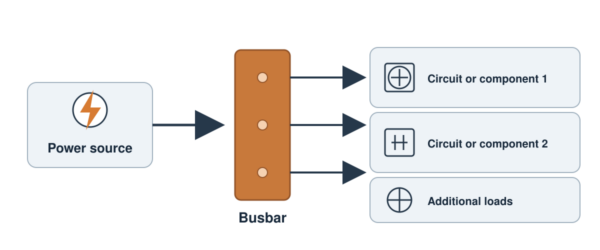
A busbar provides a common conductive path that distributes current from a power source to multiple electrical loads.
Types of busbars by construction
Rigid busbars
Rigid busbars are solid conductors, usually manufactured from copper or aluminum. They may be flat, bent, punched or otherwise formed to fit the required electrical assembly.
Flexible busbars
Flexible busbars consist of thin layers or braids of conductive material. They are used when movement, vibration, thermal expansion or alignment differences must be accommodated.
Laminated busbars
Laminated busbars contain multiple conductive layers separated by insulating materials. They can provide compact power distribution and controlled electrical characteristics in applications such as converters, inverters and power electronics.
Insulated busbars
Insulated busbars have a protective insulating layer that reduces the risk of accidental contact and short circuits. Insulation can also allow conductors to be installed closer together.
Custom-formed busbars
Custom busbars are manufactured according to application-specific drawings and requirements. They may include bends, punched holes, threaded connections, joints and surface treatments to enable direct installation into the customer’s assembly.
Common busbar system configurations
Single busbar system
A single busbar system is the simplest busbar arrangement. It is cost-effective and relatively straightforward to operate, but it provides less operational flexibility and redundancy than more complex configurations.
Double busbar system
A double busbar system uses two separate busbars. It provides greater operational flexibility and can allow loads to be transferred between the busbars during maintenance or changing operating conditions.
Main and transfer busbar system
A main and transfer busbar system consists of a primary busbar and a secondary transfer busbar. The transfer busbar can be used to maintain power distribution when parts of the main system require maintenance.
Ring busbar system
A ring busbar system is arranged in a loop. This configuration provides a high degree of reliability because a fault or maintenance requirement in one section can be isolated while other sections remain in operation.
Sectionalized busbar system
In a sectionalized system, the busbar is divided into separate sections. Individual sections can be isolated for maintenance or fault management without necessarily shutting down the entire system.
Advantages of busbars
1. Electrical efficiency
The low electrical resistance of copper and aluminum busbars enables efficient current transfer. Correct material selection, sizing and connection design help reduce voltage drop, power losses and unwanted heat generation.
2. Compact construction
A busbar can replace multiple cable connections and provide accurately positioned connection points in a compact assembly. This is particularly useful in electrical cabinets, power electronics, battery systems and industrial equipment.
3. Reliable connections
Rigid busbars provide stable connection points between electrical components. Correctly designed contact surfaces, holes, joints and surface treatments help maintain reliable electrical performance throughout the service life of the assembly.
4. Efficient heat dissipation
The flat shape and relatively large surface area of many busbars can support effective heat dissipation. Thermal performance must nevertheless be considered as part of the overall electrical and mechanical design.
5. Customizable design
Busbars can be manufactured in application-specific shapes and dimensions. Cutting, punching, bending, finishing and surface treatment allow the component to be integrated directly into the customer’s electrical assembly.
Applications of busbars
Power generation and substations
Busbars carry and distribute current between generators, transformers, switchgear and outgoing circuits. The busbar configuration depends on factors such as current capacity, voltage level, reliability and maintenance requirements.
Electrical and industrial equipment
Custom copper and aluminum busbars are used inside switchgear, electrical panels, transformers, converters, inverters and industrial machinery. They provide compact and accurately positioned high-current connections between components.
Battery and energy storage systems
Busbars connect battery cells, modules, power electronics and other components in battery and energy storage systems. Material, dimensions, insulation and connection design must be selected according to the required current capacity and operating conditions.
Data centers
Busbars and busbar systems are used to distribute power efficiently within data centers and their electrical infrastructure. Compact construction, reliability and high current-carrying capacity are particularly important in these environments.
Electric vehicles and charging equipment
Busbars are used in battery packs, power distribution units, inverters and charging systems. These applications often require compact components with precise dimensions and reliable connections.
Renewable energy systems
Solar and wind power systems use busbars in inverters, converters, switchgear and energy storage equipment to transfer and distribute electrical power.
Copper vs. aluminum busbars
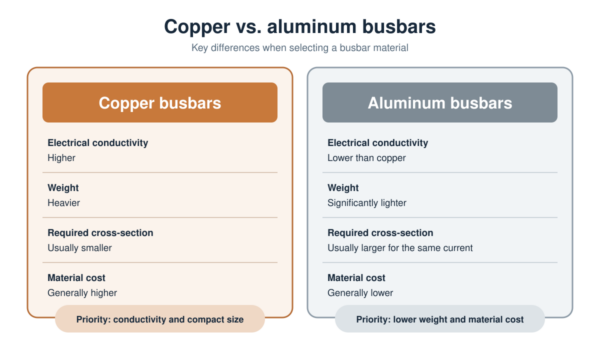
Choosing the right material is crucial for busbar performance, longevity, and cost-effectiveness. Here is a comparison between copper and aluminum, the two most commonly used materials for busbars:
Copper busbars
- Conductivity: Copper is known for its superior conductivity, making it ideal for applications requiring minimal power loss.
- Durability: Copper is highly resistant to corrosion and wear, leading to longer-lasting busbars, especially in demanding environments.
- Heat tolerance: Copper has excellent heat tolerance, which means it can handle high-current loads without excessive temperature rises.
- Cost: Copper is typically more expensive than aluminum, but the higher cost can be offset by its efficiency and longevity.
- Applications: Due to its high performance, copper is preferred in high-demand sectors like power generation, substations, and industrial facilities.
Learn more about Copper Busbars >>
Aluminum busbars
- Conductivity: Aluminum has good conductivity, though slightly lower than copper. It is effective in applications where reduced weight and cost are priorities.
- Weight: Aluminum is much lighter than copper, making it easier to handle and install, which is advantageous in applications requiring a lighter system.
- Cost: Aluminum is generally less expensive than copper, making it a cost-effective choice for many applications, especially where budget constraints are a factor.
- Corrosion resistance: While aluminum has natural corrosion resistance, it may require coating or treatment to prevent oxidation in certain environments.
- Applications: Aluminum is often used in automotive, aerospace, and residential sectors, where its lightweight nature and cost-effectiveness are essential.
Learn more about Aluminum Busbars >>
For more details on the differences between copper and aluminum busbars, you can visit the copper vs. aluminum busbar page for further reading.
Frequently asked questions about busbars
What is a busbar?
A busbar is a solid metal conductor that collects and distributes electrical current between multiple circuits or components. It is usually made from copper or aluminum.
What is a busbar used for?
Busbars are used to transfer and distribute electrical power in equipment such as electrical panels, switchgear, substations, battery systems, converters, inverters and industrial machinery.
How does a busbar work?
A busbar receives electrical current through one or more incoming connections and provides a low-resistance conductive path to multiple outgoing circuits or components.
Why are busbars used instead of cables?
Busbars can provide compact construction, rigid connection points and efficient high-current distribution. Whether a busbar or cable is more suitable depends on the electrical system and application.
Is a busbar AC or DC?
A busbar can carry either alternating current or direct current. Its material, dimensions, spacing, insulation and connection design are selected according to the requirements of the AC or DC system.
What is the difference between a busbar and a busbar system?
A busbar is an individual conductive component. A busbar system consists of one or more busbars together with supports, insulation, enclosures, connections and other components required for power distribution.
What is a power busbar?
A power busbar is a busbar used to transfer or distribute electrical power within a system. The term describes its function rather than a completely separate busbar type.
Are busbars insulated?
Busbars may be bare, coated or fully insulated. Bare busbars are normally protected against accidental contact through an enclosure, barriers or their installation location.
Which is better for busbars, copper or aluminum?
Copper offers higher electrical conductivity and enables a smaller cross-section. Aluminum is lighter and generally less expensive. The correct choice depends on the electrical, mechanical, environmental and commercial requirements.
Can busbars be manufactured according to customer drawings?
Yes. Custom busbars can be cut, punched, bent, finished and surface-treated according to customer drawings and application-specific requirements.